



This GCSE revision guide covers the habits top-performing Year 11 students share.
Year 11 is one of the most important years of your education. It is the year that will determine your GCSE results and, for many students, influence their A-Level, college, or apprenticeship opportunities. At Ruby’s Tuition, we have seen that the students who perform best often share the same habits we mention in the guide. These exams don’t rely on you simply being clever; they rely on developing an effective revision technique and staying disciplined.
Consistency
One of the biggest mistakes is students thinking that they can leave revision until Christmas or Easter. The truth is you’ll be learning new content from the start of September. So, you’ll have to revise not only the new content but also the old content. Additionally, Y10 content tends to form a baseline for Y11 content, and you will be tested through mocks and tests.
Your brain remembers information better when you review the information regularly. Techniques such as active recall, spaced repetition, and regular self-testing are far more effective than simply reading your notes over and over again. If you revise a little every day, by the time your mock exams and final GCSEs arrive, you’ll already know most of the content and simply be refreshing your memory instead of learning everything from scratch.
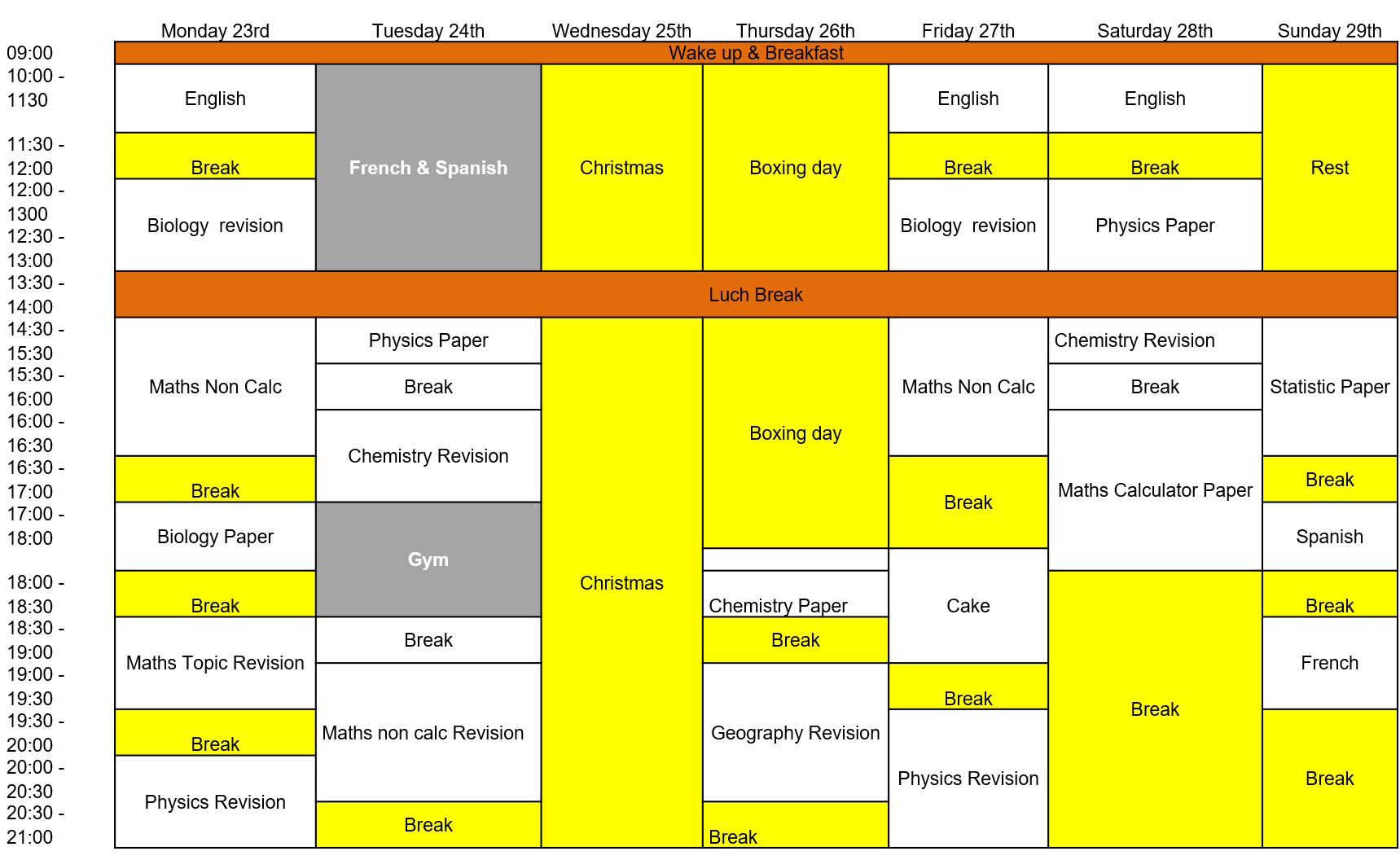
How to make a GCSE revision timetable?
The biggest challenge for most Year 11 students is knowing where to begin.
Should you revise what you’re learning in class today?
Should you revisit Year 10 topics?
Should you focus on your weakest subjects?
The answer is all three. For each of your GCSE exams, you should break down the specification into individual topics. For example, mathematics might be algebra, probability, simultaneous equations, etc.
Once you have written the list, you should rate the topic based on your confidence level:
- Red – struggling
- Amber – need more practice
- Green – confident
Identifying the topics you are weak in lets you focus on them and revisit them regularly. Be truthful when ranking; it’s completely confidential and only for your benefit.
How much should you revise?
There isn’t one perfect answer because every student learns differently. What matters is the quality of your revision, not the number of hours you spend at a desk. That being said, summer holidays give you so much more free time to revise. So I would suggest:
- Weekdays – 3 hours
- Weekends – 5/6 hours
Whether you prefer short breaks or long breaks. A common technique would be the Pomodoro timer. Revise for 25–45 minutes, take a short 5–10 minute break, then repeat. This helps you stay focused and prevents burnout.
Revising smarter
There is no point in passively reading your textbooks. Real revision is meant to help you learn and revisit topics. You can use the following techniques:
- Active recall: test yourself without looking at your notes.
- Past papers completed under timed conditions.
- Flashcards for key facts, quotations, vocabulary, and formulae.
- Knowledge organisers that summarise each topic.
- Teaching someone else what you’ve learned.
- Study in groups with friends and revise topics. Everyone tends to remember things differently, so helping each other is a collaborative way to gain different insights. This works well in English, where interpretations of quotes are subjective.
- Exam questions are marked using official mark schemes. You can ask your tutors @ Ruby’s Tuition to mark these and give feedback.
Don’t be afraid to ask your tutor to mark your work and give you feedback. Knowing why you lost marks is just as important as knowing your final score.